
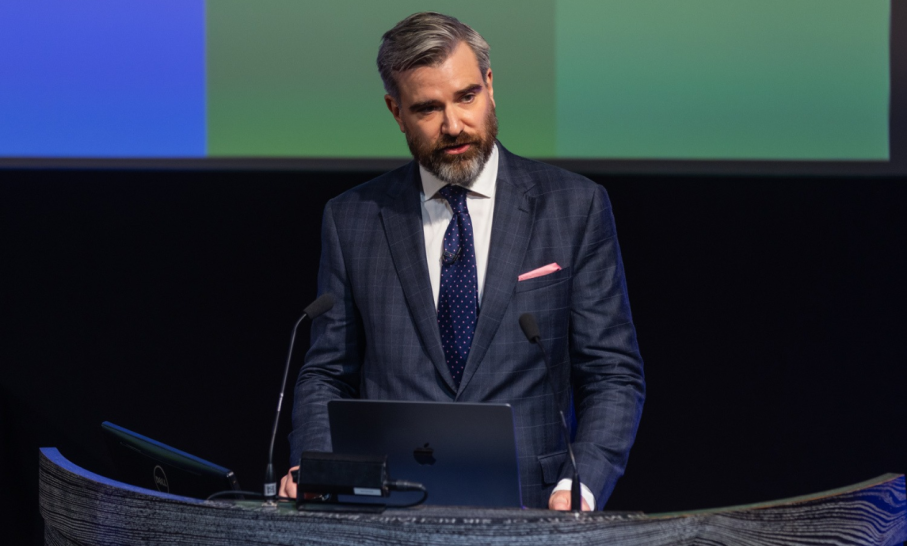
Below is the full transcript of the opening address delivered by Alex Proudfoot, Chief Executive of Independent Higher Education, at the IHE Annual Conference 2026 on Wednesday 18 November 2026.
Good morning everyone, and welcome to the IHE Annual Conference. Same venue as last year. Same skills minister following me, but so much else had changed. Our new Prime Minister is preparing to publish a ten-year plan for the country, built around an ambition to rewire the state and reindustrialise Britain. Manchesterism for the nation. Which I’m told does not guarantee a Hacienda in every post code.
But reindustrialisation cannot mean a trip down memory lane to the factory line. We cannot recreate the economy of the past. If it is to succeed, it must surely start by strengthening the industries in which Britain already has a genuine global edge. Financial and professional services. Health and life sciences. Defence and aerospace. AI and technology. Creative and cultural industries. Engineering and the built environment. Professional sport. And, yes, higher education. These sectors are already building our future prosperity. And there are IHE Members specialising in every one of them. Because none can succeed without the talent, skills, specialist knowledge and innovation that higher education provides.
It is both a globally successful industry in its own right, and the essential infrastructure behind every flourishing sector today. Nowhere is this clearer than in our creative industries: dance, theatre, film, fashion, music, design and live events. With more than 30 creative members, IHE is proud to belong to the Creative Education Coalition, whose recent manifesto makes the essential point that globally successful creative industries require a strong and accessible creative education ecosystem.
Independent higher education at a glance
Today we publish the first annual report in our new State of the Sector series, combining analysis of official data with the responses to our annual survey. I will spare you all 74 pages and use a few figures to illuminate the choices facing the sector and the country.
Independent providers now educate 169,805 students. That is almost one in every 17 students in UK HE. Student numbers have grown by 123 per cent since 2018/19, compared with 13 per cent among traditional providers. And 91 per cent of independent providers are specialists.
Independent higher education is not a marginal interest but a substantial, fast-growing and responsive sector, deeply embedded in the industries that give Britain its global edge.
IHE and HERA at ten
This year marks ten years since our relaunch as Independent Higher Education. IHE has grown from a few dozen members into the buzzing and diverse community of almost 100 institutions that you sit amongst today. It is also ten years since the government white paper that led to the Higher Education and Research Act. HERA promised a more open and dynamic system in which high-quality independent institutions could join the sector, develop their provision, gain full autonomy and earn recognition for their distinctive value.
This year, pointblank Music School and the Academy of Live Technology gained the independence of their own Degree Awarding Powers. Norland became the world’s first dedicated university for early childhood. These are not regulatory technicalities. They prove that specialist institutions can mature and secure recognition without surrendering their identities or conforming to a conventional university model. And we will work tirelessly to preserve these routes for the next generation of independent providers.
Growth, governance and financial sustainability
Our report reveals an ambitious sector. Seventy-two per cent expect student numbers to grow in the coming year, and three-quarters are taking action to strengthen their financial position. That ambition requires investment. New provision cannot be built on good ideas alone. We must engage earnestly with concerns about franchising, weak oversight and unethical recruitment. Whenever growth comes before quality, recruitment before honesty or revenue before wellbeing, the consequences fall first and hardest on the learner. They also damage the many institutions who care deeply about their students.
But pockets of poor practice must not become an argument against private investment or new models of provision. This sector needs capital for technology, facilities, people, R&D. Government will not be riding over the hill to the rescue with all the capital required. There is no civil service cavalry. Private investment will remain critical. Profit is not evidence of poor quality, any more than charitable status or a royal charter guarantees excellence. The tests remain effective governance, academic independence, ethical recruitment and dedication to student success.
Our task is to channel private investment towards the public good, combining commercial discipline and innovation with absolute adherence to quality and educational values. Investment matched by governance. Innovation by accountability. Growth by quality. And profit by educational purpose. That is why we refreshed the IHE Governance Code this year, used by 65 per cent of respondents who follow a formal code.
It is also why I am pleased to announce today that we have begun work on a new Code of Conduct for Domestic Agents, with Universities UK, the NUS, the Office for Students and the Department for Education all joining our advisory group. And it is why student voice is embedded through our Student Advisory Board and its Chair’s full membership of the IHE Board. Because putting students first means actually inviting them into the rooms where decisions are taken.
Regulation that protects and enables
I am optimistic that the OfS, under its new collaborative leadership, can protect an increasingly diverse student population while enabling responsible growth, investment and innovation. That requires clear expectations, proportionate scrutiny and dependable timescales, because delay is not a neutral act.
You may not have heard of The Art Academy. It was a small, specialist and inspiring higher education provider, offering intensive fine-art education and nurturing a distinctive creative community over 26 years. Its carefully developed plans for registration and growth were upended by the 2024 OfS pause. It closed this summer, and that community was lost.
OMNES Education, a successful pan-European higher education group, is closing its London campus after 30 years, after delays and process changes frustrated its plans to develop UK provision through New Degree Awarding Powers.
Regulation is never the only factor. But unpredictability is fatal for investment: capital moves elsewhere, opportunities close and institutional ambitions are abandoned. A regulator must have the strength to say no to poor practice. But a healthy system also needs a regulator capable of saying yes: yes to good institutions, yes to responsible investment and yes to innovation that benefits students.
International activity
The ambition of our members does not stop at the cliffs of Dover. Our report shows that 72 per cent of respondents are active internationally and 58 per cent are developing new activity. Their European ties remain particularly strong. Almost half of their transnational education students study in the EU. Europe is a priority for 42 per cent of those naming target markets. And almost a quarter intend to participate in Erasmus+.
That matters as the Government seeks a reset with our friends and partners across that narrow sleeve of sea. Whatever emerges from Friday’s summit, education must be central to a stronger UK-EU relationship. Our members preserved these connections through a difficult period. Now they should flourish.
But our ambition goes further.
Specialist, industry-focused higher education should become a much more visible part of the UK’s global offer. Britain should be known not only for traditional degrees, but for flexible, blended and career-changing learning. That includes short professional courses through which international visitors can update their skills, learn from our leading industries and take that expertise back into their working lives.
This year, four members shared IHE’s first stand at EAIE, the flagship European education fair. Next month, our Vice Chair Phil Deans will represent members in Nigeria, with more collaborative activity to follow in 2027. And because growth must be grounded in quality, IHE joined Universities UK and GuildHE in commissioning QAA’s new UK TNE Quality Scheme.
Britain should be the place where the world comes not only to earn a degree, but to update their professional skills, change their career trajectory, and be inspired by the industries in which this country leads.
Flexible learning and regional capacity
Global growth also depends on a sustainable domestic market. Providers need predictable funding, and students need maintenance support that makes full-time and accelerated study genuinely possible. We cannot rely on higher education for the talent behind our leading industries while allowing its infrastructure to become financially unsustainable.
The Lifelong Learning Entitlement from January offers an opportunity to create a flexible modular system we have been calling for since 2015. Today’s report shows that 48 per cent want to deliver LLE modules, while a further 16 per cent want to participate but have no eligible courses yet.
Success for the LLE cannot mean simply dividing existing degrees into smaller units. It must bring new learners into education and connect flexible provision more closely to work, family, place and industry. Nearly half of respondents teach outside London. Fifty-three per cent want greater regional engagement, and 68 per cent have goals aligned with regional skills plans. Metro mayors and regional leaders should work with all capable providers, not only the most familiar institutions.
Industry partnerships
The connections are already there. Eighty-six per cent of respondents work with industry, up from 79 per cent last year, through curriculum design, mentoring, employer training and workforce development. Yet our report also finds a decline in placements and work-based learning. That should concern us when government wants education and industry to move closer together. These relationships matter because the first step into an industry has become harder to reach for too many young people.
Milburn, NMITE and higher education cold spots
Yesterday’s report from Alan Milburn makes a powerful argument that Britain has allowed the first rung of the ladder to weaken for too many young people. That is not because young people lack ambition. Too many simply lack accessible opportunities to gain experience, enter an industry and turn learning into a working life. We should welcome the ambition that every young person has the opportunity to earn or learn.
I believe IHE members have a vital part to play here: 86 per cent work with employers, building courses around industries, professions and routes into work. Delivering on the promise of this generational review will require specialist and technical education, modular and accelerated courses, and online and blended provision. It will require government and local leaders to look beyond familiar institutions and draw on the full capacity and commitment of our sector.
The Milburn report says something particularly important for this conference:
“New models of higher education with a greater vocational focus and employer involvement should also be encouraged.”
He wrote this with our member NMITE in mind. They met with the review team earlier this year. If you don't know them, NMITE deliver project-led engineering education in close collaboration with employers, in a place historically underserved by higher education. The FT reported that 90 per cent of its latest graduating cohort had already secured employment. A Policy Exchange report this month proposed NMITE-style institutions in other cold spots across the country, identifying 57 sizeable English towns and cities without a university of their own, representing around 5.5 million people.
Today's IHE report shows the capacity for growing career-focused provision across our sector. Milburn identifies the urgent need. NMITE demonstrates a possible model in practice. Policy Exchange proposes how it could be replicated. Widening participation must mean not only more people entering higher education, but different institutions, in different places, offering different forms of learning. This is not about lowering academic ambition or diverting young people from higher education, but connecting the learning available to them more closely to work, industry and place.
The system Britain needs
Ten years ago, HERA opened the door to a more diverse sector. I am proud that IHE has grown into a supportive and indispensable community for so many of the institutions who walked through it. The next decade must make this diversity work in a cohesive but flexible national system that meets regional economic needs: more routes into learning, more opportunity in underserved places, stronger connections with industry, and a system confident enough to welcome new institutions and ideas.
Reindustrialisation is not about recreating yesterday’s economy. It is about strengthening the industries in which Britain has a global edge and spreading the growth and opportunity they create across the whole country. The question for us government is no longer how independent higher education can be shoehorned into the education system we have. It is what kind of system we actually need today, and who is already building it.
If Britain wants to strengthen its most successful industries, revive its regions and reconnect a generation with opportunity, higher education is not a second-order issue. It is one of the places we must start.